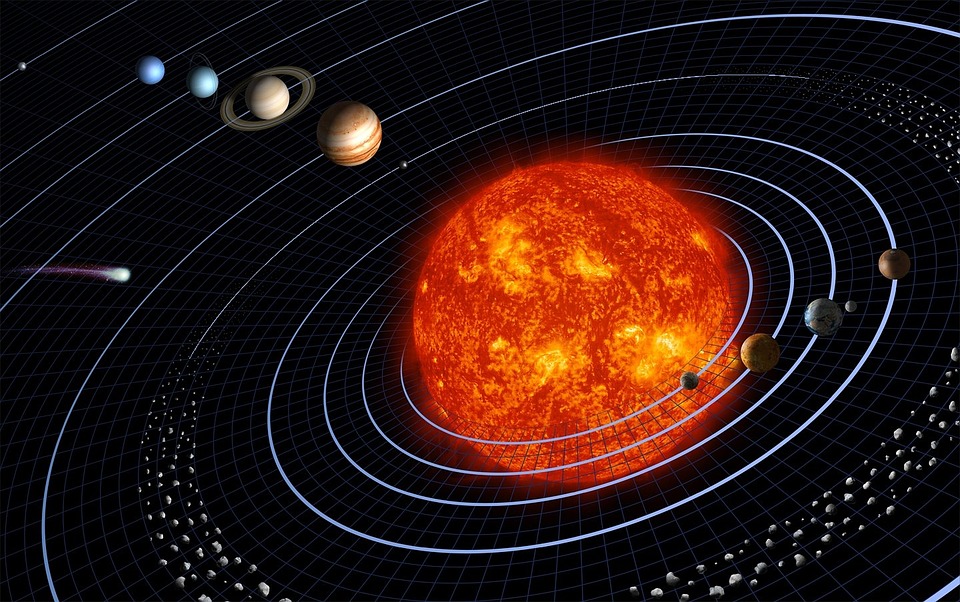
The star at the center of the solar system plays a special role for us here on earth. It was formed about 4.5 billion years ago, in the Orion spur (in the milky way galaxy). It was born from the collapse of a cloud and dust called the “solar nebula”. It then condensed into a burning ball of gas, called the sun.
What makes the sun the heart of our solar system?
- Its magnetic field
- Its gravitational pull.
The sun’s magnetic and gravitational impacts are largely due to its size. It is large enough to hold the solar system intact, it is about 100 earths wide, and it could theoretically fit all 8 planets nearly 600 times. Additionally, it contains about 99.8% of all the mass in the solar system.
If you are guessing that this is why planetary bodies orbit it, you are right. Because of its mass, it has a great pull on the fabric of space, creating a gravitational force that causes nearby bodies to be drawn towards it. Without this pull, the other planets will vanish into deep space.
The magnetic field of the sun is called the heliosphere, and it encapsulates the entire solar system. It protects the planets form harmful cosmic radiation. It is caused by the sun’s plasma, and it causes the pushing of particles towards its poles.
Will the sun last forever? Unfortunately not. It is expected to collapse into a white dwarf in about 6.5 billion years, after it runs out of its hydrogen fuel. That’s such a depressing thought. I hate to imagine what will happen to our existence as a result of this. Maybe we should think of ways to refuel the sun? Or maybe we should just refrain from worrying about things we cannot change. In the meantime, let’s enjoy the sun’s magnetic field, gravitational pull and vast amounts of energy.

 ASTR 2110